

Incoming & DMC
Tour Route: BlueMosque, HagiaSophia, TopkapiPalace, BasilicaCistern, Hippodrome, OrtakoySquare,


The city tour will start at the Old City after a delicious breakfast at your hotel.
The first stop is the Hippodrome, which was inscribed on the UNESCO World Heritage List in 1985. It is a living heritage of both the Byzantine and Ottoman eras.
Around Sultanahmet Square, you'll see several historical monuments:
The German Fountain, a gift from German Emperor Wilhelm II in 1898.
The Obelisk of Theodosius, which is nearly 3,500 years old and was brought to the Hippodrome by Emperor Theodosius from the Temple of Karnak around 390 AD.
The Serpent Column, originally from Delphi, and
The Column of Constantine brought from the Temple of Apollo in Rome.
Next, the tour continues to the Blue Mosque (Sultanahmet Mosque). Its breathtaking design synthesizes 200 years of Ottoman mosque architecture with elements of Byzantine church design. The mosque reflects majesty and grandeur through its architectural features. The interior is adorned with beautiful green and white Iznik tiles, complemented by the stunning blue ornaments of the dome.

Hagia Sophia Mosque which is referred to as the “8th Wonder of the world” is another amazing site that is more than 1,500 years old. The light creates a fascinating atmosphere while flowing inside from the dome windows, combining a colorful, mystic view when it reaches the mosaics on the wall. . Hagia Sophia Museum, the legacy of both Christian and Muslim culture, was opened for visits according to the order of Ataturk and decision of the Turkish Assembly of Ministers on the 1st of February, 1935.
One of the magnificent ancient buildings of Istanbul is the Basilica Cistern located in the southwest of Hagia Sofia. Constructed for Justinianus I, the Byzantium Emperor (527-565), this large underground water reservoir is called as “Yerebatan Cistern” among the public because of the underground marble columns. As there used to be a basilica in the place of the cistern, it is also called Basilica Cistern.

Topkapi Palace, a relic of the glory days of the great Ottoman Empire. The former palace boasted a population of about 4,000 people at its peak and was home to 25 sultans over a period of 400 years. Located on a promontory overlooking the Golden Horn, it sits in tranquil gardens that provide shade from the blazing heat of the summer. Pop in to the museum to see the gorgeous Iznik tiles and the ornate stateroom of the harem, among other attractions.

Turkish Night entertainment awaits while you dine on the Bosphorus with Cruise in the evening…

Tour Route: Dolmabahce Palace, Taksim Square, Istiklal, Galata Tower

Dolmabahce Palace was built by Ottoman Sultan Abdülmecid (1839-1861) on an area of 110,000 square meters between the years 1843 and 1856. Its construction on the edge of the Bosphorus was accepted as an indication that the Ottomans broke the traditional connection with the past. You know they used to rule the empire from the Topkapi Palace and on the Historical Peninsula. The palace houses more than 50,000 objects along its hundreds of rooms. The interior of the palace reflects the grandeur of the epoch, and designed like the luxurious European palaces. The giant crystal stairs and chandeliers, large oil paintings and armchairs are very attractive. The precious watches of the palace will take your interest
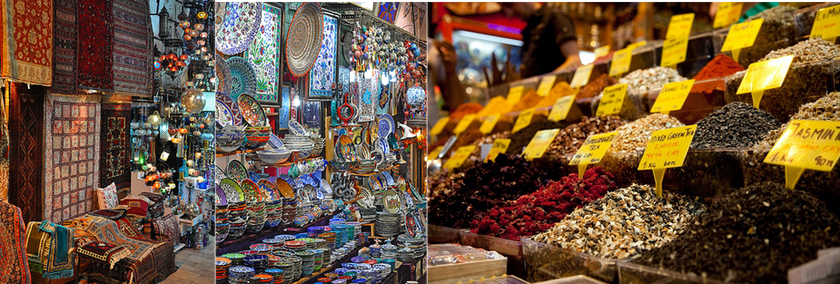
The Grand Bazaar is one of the largest and oldest covered markets in the world. With hundreds of small handcraft shops selling everything from handmade carpets to Turkish coffee, the atmosphere is electric, and it's a great place to try out your bargaining skills. The Grand Bazaar is spread over an area of 110,868 m2 and has a closed area of 45 thousand m2, 3600 shops and 14 inns on 65 streets. Although most of them have undergone changes today, it is possible to understand what was made and sold there in the past with the names of the streets and inns of the Grand Bazaar. The spice bazaar is located in Fatih. It's known as the Egyptian Market because during the Ottoman period, Egyptian exports were sold there.

This neighborhood of Istanbul was once known as the Jewish quarter of the city. Today you can still find many synagogues here, as well as a more diverse group of residents.

This morning we hit the road and drive to Bursa, the former capital of the Ottoman Empire. Sites we will visit include the famous Grand Mosque and the historical Silk Bazaar.
The journey takes about 90 minutes from Istanbul to Bursa…

Sapanca is known as close to Istanbul with its magnificent nature.
Sapanca lake is one of the most famous lake of Turkey


Devrent Valley, Pasabag, Goreme Museum, Avanos, Uchisar
Our first real encounter with Cappadocia almost Martian landscape is in the Dervent valley. We visit Pasabag's “fairy chimneys”, where the voice of the wind harmonizes with songs of the fairies. From here we pause at Avanos center of terracotta art which is a popular destination because of its attractive old town with cobbled streets, and views over the river and is its production of earthenware pottery, it is also the most economic activity in the town. The ceramic trade in this district and its countless pottery factories date right back to the Hittites, and the ceramic clay from the red silt of the Kızılırmak has always been used. A visit to ceramic & tile center to see how the ceramics are made by hand. After lunch we visit the famous Goreme Open Air Museum to see the best examples of Byzantine art in Cappadocia. People of Goreme, at the heart of the Cappadocia Region, realized that these soft rocks could be easily carved out to form houses, churches, monasteries. These Christian sanctuaries contain many examples of Byzantine art from the post-iconoclastic period. These frescoes are a unique artistic achievement from this period. You visit a carpet cooperative, where you'll see how exquisite Turkish carpets are hand-woven. We complete the tour with a panoramic view of the valleys of Cappadocia.

Depart from your hotel to visit Red valley through Cavusin and explore the famous rock-cut churches and hike 2 km. Then visit Cavusin village. Old Cavusin was abandoned several decades ago due to avalanches. The current village of Cavusin is located on the road. Old Cavusin, with its rock-cut dwellings and stone houses, had several hermitages. After lunch drive to the Pigeon Valley. In the afternoon visit Underground City, where early Christians lived in fear and faith. The houses in the village are constructed around the nearly one hundred tunnels of the underground city, which is one of the most interesting underground settlements in Cappadocia. The underground city was originally carved out as eight floors; However four floors are available to visit. In wartime about 5000 people can refugee. The tunnels are still used today as storage areas, stables, and cellars.

PAMUKKALE DAYS Pamukkale & Aphrodisias
Pamukkale is one of the rare places in the world that has been included in the UNESCO World Heritage List with its natural and cultural features. Pamukkale Travertines, located in Denizli, seem to be covered with a white cover due to the carbonated water it has. The white travertines formed by the waters containing calcium oxide from Çaldağı give Pamukkale a unique appearance
It is due to the exceptionally well-preserved structures, largely made of marble, and their associated reliefs and inscriptions, revealing an intense exchange of ideas and values from the Late Hellenistic to the Roman and Byzantine periods. Aphrodisias, AD 1.-5. It has trained sculptors who have gained great fame in the whole Mediterranean world between the centuries, and whose works bear their signatures all over the Empire, especially in Rome. The rare proximity of marble quarries to the city is an important reason why Aphrodisias became a high-quality production center for marble sculpture. Thanks to this feature, it became one of the cities in the Asian Province of the Roman Empire, which enabled the marble art and architecture of the period to be researched and understood in all aspects.


İZMİR DAYS Sirince - Selçuk - Ancient City Of Ephesus - House Of The Virgin Mary
One of the rare Greek villages in our Aegean region that has not lost its historical, cultural and natural texture, 8 km from Selçuk, which met the water needs of the Ancient City of Ephesus in ancient times, the Tahta Bridge is a short village walk through the olive groves that adorn the Aegean flora, accompanied by a magnificent view of nature. ,St. After our visit to the St. Jean Church, we complete our walk in the narrow streets lined with old Greek houses and visit the wine house to taste the fruit wines unique to Şirince, which we cannot find anywhere else in Turkey. After our trip to Şirince, we start to visit the ancient city of Ephesus, which has been excavated for 100 years and only 10% of which has been excavated yet. In the Ancient City of Ephesus, which is one of the most solidly surviving cities of the Ancient Aegean World; The historical texture of Ephesus draws us into the depths of history. After our visit to Ephesus, the House of the Virgin Mary, which is considered one of the holiest places of Christianity and where the Virgin Mary spent the last days of her life, is our other visiting point. After visiting the Pool, Church and Ayazma, we go to the hotel.


CAPPADOCIA & KONYA & ANTALYA TOURS
One of the rare Greek villages in our Aegean region that has not lost its historical, cultural and natural texture, 8 km from Selçuk, which met the water needs of the Ancient City of Ephesus in ancient times, the Tahta Bridge is a short village walk through the olive groves that adorn the Aegean flora, accompanied by a magnificent view of nature. ,St. After our visit to the St. Jean Church, we complete our walk in the narrow streets lined with old Greek houses and visit the wine house to taste the fruit wines unique to Şirince, which we cannot find anywhere else in Turkey. After our trip to Şirince, we start to visit the ancient city of Ephesus, which has been excavated for 100 years and only 10% of which has been excavated yet. In the Ancient City of Ephesus, which is one of the most solidly surviving cities of the Ancient Aegean World; The historical texture of Ephesus draws us into the depths of history. After our visit to Ephesus, the House of the Virgin Mary, which is considered one of the holiest places of Christianity and where the Virgin Mary spent the last days of her life, is our other visiting point. After visiting the Pool, Church and Ayazma, we go to the hotel.
